Home / Product terms / The lock-up tier
Launchpool: why the reward misses the estimate
Launchpool is the tier most often sold as “free money”. The lock is genuinely loose — but what it hands back is nothing like the first two tiers, and you cannot know how much of it you will get before you commit.
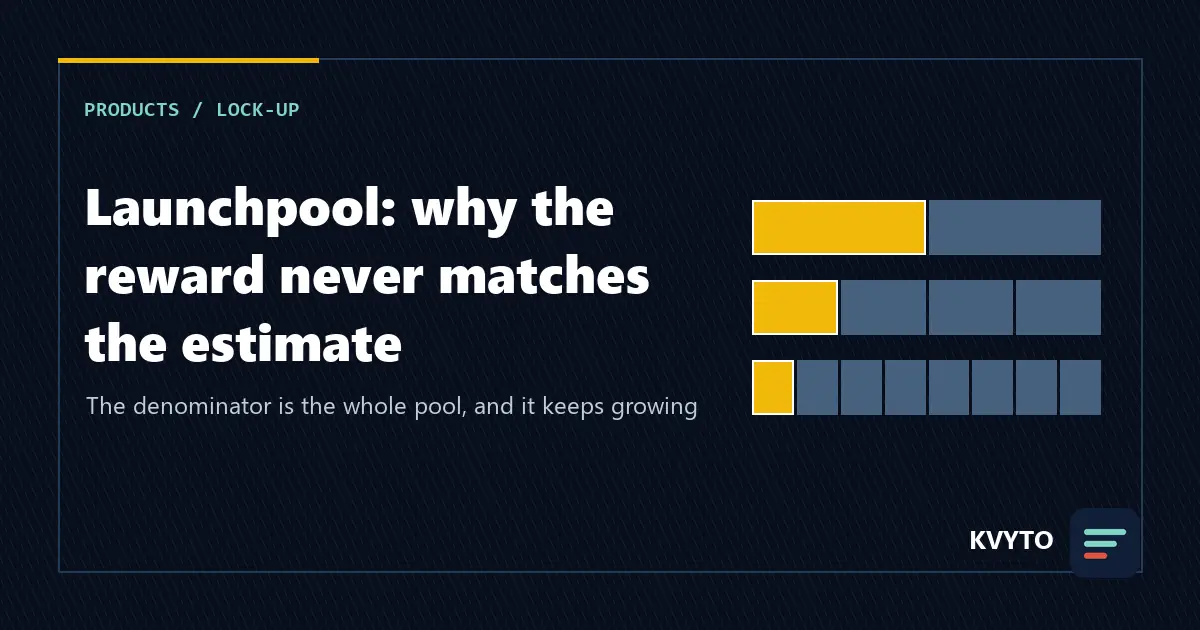
With Flexible, Locked and Dual Investment you at least know which coin comes back. The lock-up tier changes that: you lock BNB and receive a token that has not listed yet, in a quantity set by how many other people showed up, worth whatever it sells for once trading opens. Neither of those is knowable at the moment you lock.
What this covers
- The “lock” is far looser than the name suggests
- Three different things are called “locked”
- What you get is not interest, it is an unlisted token
- Why the estimate shrinks: the denominator moves
- You may already be taking part without knowing
- The real cost is not the lock-up, it is why you hold BNB
- Five things in the fine print the page does not flag
- The hours after the token lands are where this is decided
- There is only one honest way to score this tier
- Where it actually sits among the four tiers
The “lock” is far looser than the name suggests
The word lock-up suggests this behaves like a Locked product — in until maturity. It does not. Binance's own Launchpool page states it plainly: the assets you commit can be unlocked at any time, and one tap on Unlock sends them back to Spot.
So measured by the question this site keeps asking — when do I get this money back? — Launchpool actually scores better than Locked: roughly like Flexible, whenever you want. What is really tied up here is something else, and the rest of this piece is about that.
One more piece of timing worth remembering: rewards accrue hourly, and you can tap Claim to move them into Spot whenever you like. Even if you forget entirely, any unclaimed airdrop plus your locked principal lands back in Spot within 90 minutes of the pool closing. Nothing expires for want of claiming.
One line to keep: Locked ties up your money, Dual Investment ties up the form your principal takes, and this tier ties up your knowledge of the payoff — when you agree to take part, you do not know how much you will get or what it will be worth.
Three different things on the Earn page are called “locked”. Only one is this
“Locked” gets reused a lot on Binance's Earn pages, and it covers at least three products whose redemption rules have nothing in common. Read them as one thing and you will end up with conclusions that contradict each other.
One: Launchpool farming (this article)
You lock BNB or whatever coin the campaign accepts, you can unlock any time, and what you receive is somebody else's new token. The “lock” here is closer to a bookkeeping label — it marks the balance that is currently earning a share, it does not hold the balance hostage.
Two: Locked Products, the fixed-term kind
A stated term, and terms that say the principal comes back at maturity. This is the one that is locked in the ordinary sense of the word. Some of Binance's Locked Products currently allow early redemption and claw back the rewards already paid out when they return your principal; others do not allow it at all. Which one you're in is a property of the specific product — the arithmetic is in what early redemption actually costs you.
Three: On-chain yields, the staking kind
You hand over the coin and get a receipt token back (WBETH and BETH from ETH staking are exactly this), and the yield comes from the chain rather than from the platform. Redemption is gated twice over: by the platform's own processing, and by the chain's exit queue. Ethereum's validator exit queue exists at the network level; when it is congested you wait, and no amount of urgency on the platform side changes that. If you want spot back immediately, the usual route is selling the receipt token on the market and accepting whatever spread you get that day.
Put the question this site keeps asking to all three — when do I get this money back? — and the answers are any time / at maturity, or now for a price / not entirely up to the platform. Same two words on the page, three different tiers underneath.
One way to sort them: Launchpool is the one you can walk away from at any time, while the on-chain staking family puts money you set aside for yield in a queue you have no control over. If that queue bothers you, that alone is a reason to skip it — not because it is bad, but because it doesn't match what the money is for. That's a way of sorting, not a recommendation.
Whether a specific product allows early redemption, and how long it takes, is on that product's own terms page. We checked the rules for all three families in September 2026.
What you get is not interest, it is an unlisted token
Flexible and Locked return the coin you put in: deposit USDT, receive USDT. That is why the homepage table describes both of those rows as principal unchanged when measured in coin.
Launchpool is a different animal. You lock BNB and you receive whatever new token the project has set aside for distribution. Two separate unknowns sit on top of each other:
- The quantity is unknown. Your share depends on what fraction of the total pool your stake represents. The more everyone else locks, the smaller your slice.
- The value is unknown. A token that has not listed has no market price, and nobody can tell you how the first day of trading will go. “I got 1,000 of them” can mean a few hundred dollars or a few dozen.
Stack those two and you have the real difference from the first two tiers: those pay a return you can bracket in advance, this one pays the expected value of a lottery ticket. That is not a criticism — it is a statement that this belongs in a different category and should not be measured with the same ruler.
Why the estimate shrinks: the denominator moves
This is the classic disappointment with these campaigns. The projected APR looks excellent in the first day or two of the pool, and when the campaign ends the actual payout is noticeably below it. It is easy to read that as the platform changing the rules. It did not. The formula was always going to do this.
Binance publishes the hourly reward calculation:
Hourly reward = (your locked amount ÷ total locked in the pool) × (that day's pool allocation ÷ 24)
The numerator is you; the denominator is everybody. Binance also takes several snapshots per hour of both your balance and the pool total, then averages them — it is not one instantaneous reading.
Read the formula and the shrinkage explains itself. The allocation in that second bracket is fixed by the project; it does not grow because more people turned up. More participants means a bigger denominator, which means a smaller slice each. And on day one, when the pool holds the least money, the denominator is at its smallest — which is exactly when the page computes that flattering projection.
Over the next couple of days, everyone who saw the high number locks their BNB in, the denominator climbs, and your share is diluted the whole way. The correct reading of that projected figure is “assuming nobody else joins between now and the end”, an assumption that essentially never holds.
Worth separating from the Tiered APR on Flexible, because the two get confused: tiered rates dilute you when your own balance crosses a cap, which has nothing to do with anyone else. Launchpool dilutes you because of other people — you do nothing and your share still falls. Two different mechanisms behind the same complaint; the tiered one is covered in Tiered APR vs base APR.
Run the formula yourself — it beats reading the estimate
The formula reads as abstract until you put numbers in it. The ones below are made up to show how the denominator eats your share; they are not any real campaign's figures.
Say a campaign hands out 240,000 tokens on a given day and you lock 100 BNB. At the moment the pool opens there is 1,000,000 BNB in it, so your share for that hour is 100 ÷ 1,000,000, multiplied by 240,000 ÷ 24 (that is 10,000) — one token. The page extrapolates that rate across the whole campaign, which is why the opening estimate always looks generous.
Two days later the pool holds 3,000,000 BNB. You have done nothing; your stake is still 100. But your share is now 100 ÷ 3,000,000, and that same hour pays 0.33 instead of 1. Two-thirds gone, without a single action on your side.
So if you want a real estimate, don't use the opening number. Guess how big the pool will get given how much attention this campaign is drawing, and run the maths against that denominator. If you still want in afterwards, you have actually thought it through.
You may already be taking part without knowing
This one is worth real money to anyone already holding BNB: you do not need to pull BNB out of Earn and lock it separately on the Launchpool page.
Per Binance, BNB sitting in any of these counts toward your Launchpool stake and earns the same airdrop treatment:
- BNB in Simple Earn Flexible products;
- BNB in Simple Earn Locked products, at any term;
- BNB in On-chain Yields and DeFi BNB in Binance Wallet.
One exception to commit to memory: BNB in Flexible that you have pledged as collateral for Flexible Loans does not earn Launchpool airdrops. Collateral or airdrop, not both, and nothing on screen will warn you at the moment you pledge.
Also worth knowing: a Locked product still accrues airdrops hourly while an early redemption is being processed, right up until the assets are fully returned. That is one of the few pieces of good news in the early-redemption ledger; the rest of it is in what early redemption actually costs.
How to check you are actually in the pool this hour
Open the campaign page and look at the accrued-rewards figure. Creeping upward means you are in. Stuck at zero means something is off.
When rewards don't show up, it is usually one of three things: that BNB is pledged as collateral for a loan; the campaign has ended or has not started yet; or your region is not eligible. The eligibility list changes, and the page states the current one — don't go by a screenshot somebody posted months ago.
The real cost is not the lock-up, it is why you hold BNB
Which brings us to the “free money” framing, and why it needs splitting in two.
If you already hold BNB long term, parking it in Flexible to collect both interest and airdrops genuinely is close to free. You have taken on nothing extra to participate; you have simply put a risk you were already carrying to a second use.
If you bought BNB in order to take part, the ledger looks completely different. You have exchanged an airdrop of unknown value for exposure to BNB's price. Campaigns typically run days to weeks, and BNB can easily fall by more over that stretch than the airdrop is worth. At that point you are not farming a launch, you are running a spot trade with a launch as the excuse.
The test is one question: if this Launchpool did not exist, would I have bought BNB this week? If the answer is no, that price exposure is what the airdrop actually cost you, and it belongs in the accounting.
Five things in the fine print the page does not flag
One: hourly rewards under 0.01 may not be paid
Binance states that if the hourly reward works out below 0.01 tokens, it may not be distributed at all. For a small participant that can mean walking away from an entire campaign with nothing, and the projected APR on the page will not warn you. Before you lock, run the formula above on your own amount and see roughly what an hour buys you.
Two: with several pools running, the default split is even
When more than one Launchpool is live, the BNB you hold in Earn is split evenly across every active project by default. Half your position can end up mining a token you have no interest in. It is adjustable: open the Launchpool home page and use BNB Allocation (the adjust icon on the home page in the app) to set the ratios yourself. Note this is only available when multiple projects are live or upcoming.
Three: there are eligibility and regional limits
You need a verified account and residence in an eligible jurisdiction. Binance's current exclusion list includes Australia, Canada, Japan, New Zealand, the Netherlands, and the United States and its territories, among others, and that list moves with local regulation. The minimum stake is 0.01 of the coin you lock (0.01 BNB in a BNB pool, for example) — a different figure from the 0.01 reward-token cutoff above, and not a meaningful barrier for most people.
Four: once the airdrop lands, it is a spot position and the volatility is yours
The moment the tokens hit your Spot wallet they behave like any other holding — they move, and that is on you now. Claim them and leave them sitting, and by the time you look again the price may not be what it was. There is no single right answer for what to do here, but recognise the shape of it: “received the airdrop” and “turned the airdrop into money” are two separate events with a decision of yours in between.
Five: farming time and tradable time do not have to line up
The announcement carries two timestamps: when farming starts and ends, and when the token opens for trading. They are not always aligned. Some projects list while farming is still running, so you can deal with the rewards as they arrive; others only open trading after farming closes, and in between you hold a token you cannot sell.
So don't assume “I can only sell at the end”, and don't assume “I can sell whenever” either. Copy both timestamps out of the announcement before you join. This one isn't really a trap, it's fine print — but it decides when you even get to make the decision in point four.
The hours after the token lands are where this is decided
Rewards accrue hourly and unlocked principal goes back to Spot. But whether this tier paid off usually has less to do with how much you locked than with what you did in the first hours of trading.
First, know where the coins are. Airdrops and unlocked principal both land in the Spot wallet. Don't go hunting for them on the Earn pages.
The book is usually thin at the open. On a freshly listed token the gap between best bid and best ask can be far wider than you're used to on major pairs, and there is less resting size behind it. Dump the lot with a market order and your fill can come in noticeably worse than the number on the screen. That is not the venue taking a bite out of you; there simply isn't that much on the other side. Limit orders, split into a few clips, cost you nothing but patience.
Whether to sell straight away is a judgement call; here is one way to approach it. Sell part of it on day one — enough to cover the opportunity cost of those days, meaning the interest that BNB would have earned sitting in Flexible — and leave the rest. The reasoning isn't that anyone can call the price; it's the opposite. Because nobody knows which way it goes, you lock in the part that makes this “not a waste of time”. Holding the whole thing hoping for a run, or clearing it in the first minute, are defensible too, as long as you know which one you're doing.
Don't reflexively park the new token back in Earn. New listings often show up in Flexible or Locked product lists soon after, sometimes with an eye-watering APR next to them. Remember what that number is denominated in: if the token drops 40%, a 30% APR on it does nothing for you. The “principal unchanged in coin terms” line on our home page comparison only means something when you want to hold that coin.
One small thing that gets forgotten: selling costs a trading fee, charged at your account's published rate and depending on whether you use the BNB discount. It has nothing to do with the referral layer. If you want to know whether this round paid, subtract it too — which is exactly the next section.
There is only one honest way to score this tier
Do not compute “tokens received × today's price”. That is a paper number. The real one takes three steps:
- Step one: write down what you actually sold for, in USDT. Anything you did not sell is not a return, it is a position — an asset you are now actively choosing to hold, which has nothing to do with the launch any more.
- Step two: subtract BNB's price move over the period. If you bought the BNB to take part, this has to go in. If you already held it, you can leave it out, but be clear that you carried it.
- Step three: compare against what the same money would have earned in Flexible. That is the real opportunity-cost benchmark — while your BNB sat in the pool it would have been earning anyway. Run it through the interest estimator at the APR of the time; it takes a minute.
Do all three and you get a number far more honest than “200% APR”. Sometimes it still looks great, which tells you that one was genuinely worth it. Sometimes it comes out near zero or negative — which is equally useful, because next time a campaign like it comes round you will know whether to bother.
Where it actually sits among the four tiers
Line up the four rows from the homepage table and this tier's position becomes obvious:
| Tier | When you get it back | What you receive | Where the uncertainty comes from |
|---|---|---|---|
| Flexible | Any time | The same coin | The APR moves daily, but within limits |
| Locked | At maturity; some allow early exit | The same coin | The APR floats too, plus a stretch of lost liquidity |
| Lock-up / Launchpool | Unlock any time | A project token, quantity unknown in advance | how many others compete what it sells for after listing |
| Dual Investment | No exit before settlement | Possibly a different coin | the price at the settlement moment |
The column to look hardest at is the third. The first two tiers hand you something certain plus a number that floats; the last two hand you something that is itself uncertain. Which is why this site keeps repeating the same instruction: decide which kind of certainty you want, then compare rates. Do it the other way round and you are comparing four percentages that do not mean the same thing.
To close. Launchpool suits people who already hold BNB for the long run and can accept that a given campaign may come to nothing. It is not a substitute for earning yield on stablecoins — the moment you swap USDT into BNB to farm a launch, you have left the stablecoin path and rejoined the one where you trade price exposure for opportunity. Neither path is better; you just need to know which one you are standing on.
The full four-tier comparison and the three layers of risk in probability order are in the stablecoin Earn guide. The rules cited here come from Binance's help centre guide to Launchpool, which we checked in September 2026. Both the rules and the excluded-region list change, so go by what the page says when you open it.