Home / Product Terms / Dual Investment isn't savings
Dual Investment Isn't Savings, It's an Option You Sold
It sits in the Earn section with an APY several times higher than Flexible. But its return structure has nothing to do with Flexible — what you get is the price of carrying risk, not interest on a loan.
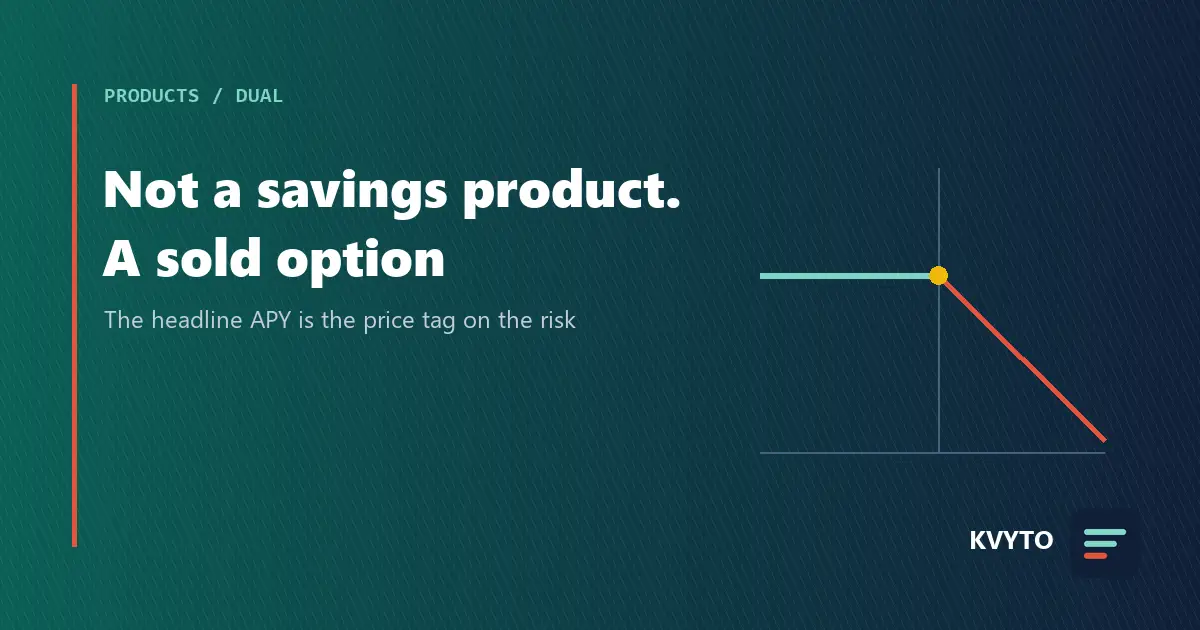
One line before you read on: Dual Investment can hand you back, at maturity, not the coin you started with but an equivalent amount of a different one, which may then keep falling. That outcome is written into the terms; it's part of the design. If you can't accept that ending, you can close this page here.
What's in here
- How it actually works
- Where the high APY comes from
- Both outcomes, spelled out
- One order, broken down into numbers
- Who it actually suits
- Products that look like it
- When people are most likely to decide badly
- Four things to confirm before you act
- If you've already been converted, what now
- The usual stories about it, one by one
How it actually works
Here it is in the plainest terms.
You deposit USDT and pick a settlement price and a maturity date. At maturity, the platform looks at the market price:
- If the price has not reached your level: you get your USDT back plus a return.
- If it has: the platform converts your USDT at your chosen price into the corresponding amount of the coin, and gives you that plus the return.
If you deposit the coin rather than USDT, the logic mirrors: the price doesn't rise to your level, you get the coin back plus a return; it does, and the coin is sold into USDT at your price.
Either direction, the common thread is: you agreed in advance to make one trade at one price, and whether that trade happens is decided by the market, not by you.
Where the high APY comes from
This is the crux. Flexible interest comes from what borrowers pay. Dual Investment's return comes from somewhere entirely different; it's a fee someone pays you for agreeing to take the other side at a set price.
The platform's own page does not present it as a savings product. Binance's help-centre page on Dual Investment files it under structured products, states that the outcome is decided by the market price at settlement, notes that the funds cannot be taken out before the settlement date, and carries a separate market-volatility warning. That is a long way from “high-yield Earn product”, and it is worth reading for yourself before you subscribe. We checked that page in September 2026.
In financial terms, you sold an option and what you receive is the premium.
The buyer is paying for the right to trade with you at the agreed price at maturity. The more likely the market thinks that is, the more expensive the premium, and the higher the APY you see.
So that attractive APY is really a price tag on a probability: the higher the APY, the more likely the market thinks you'll be converted. Reading it as the platform being generous gets the direction exactly backwards.
Once you see that layer, a lot of things line up: why the APY rises as the settlement price gets closer to the current one (more likely to happen); why the APY spikes in violent markets (more uncertainty, pricier premium); why a longer term doesn't necessarily pay more (more time means the price could be anywhere).
Both outcomes, spelled out
We'd suggest one thing before anyone places an order: write each ending as a sentence, including what you'd be holding and what you'd do about it.
Outcome one: not converted
You get USDT back plus the return. The money is back at the starting line and you have to find somewhere for it again. Note the gap here: between settlement landing and your next arrangement, the money usually sits in Spot earning nothing. Roll short-term products a few times and those gaps add up to a real bite out of the return.
Outcome two: converted
Your USDT has been converted into the coin at the agreed price. Notice the state of the market at that moment: the price triggered, which means it moved that way. You are now holding the coin, and the market has just moved down (or up, if you deposited the coin).
Now you face a new decision: hold or sell? If you sell, your sale price is usually worse than the settlement price, and that gap is your real loss. If you hold, you've gone from being someone who wanted interest to being someone holding a volatile asset, which may not be what you set out to do at all.
Having written both sentences, plenty of people discover they don't want ending two at all. Don't leave out the quantities: instead of "converted into coins", write "converted into roughly this many, worth this much at today's price". Once the quantity is on the page, whether you're willing to accept it usually becomes very clear.
One order, broken down into numbers
Concepts stay abstract, so here's a hypothetical worked through. The numbers illustrate the structure and don't represent any actual product's terms.
Say you have 10,000 USDT and pick a "convert to coin if the price falls to this level" product, seven-day term, with a very high APY on the page.
Interest first. However high the APY, seven days is seven days. On 10,000 principal over seven days, even at 50% annualised, the interest is under 100 USDT. Use the estimator to turn the APY into an amount and you'll see what "high APY" actually comes to.
Now the conversion size. If it triggers, your entire 10,000 USDT converts at the agreed price. Your assets have just gone from "a stablecoin whose price doesn't move" to "a volatile asset that has just broken through a level" — the whole amount.
Put the two numbers together: for under a hundred dollars of interest — and you only get that if the product settles normally and the platform honours its terms — you exposed 10,000 of principal to becoming a volatile asset. That doesn't mean the trade is necessarily bad. If you genuinely wanted to buy at that price, it can be a good one. But if all you wanted was that sub-hundred-dollar interest, the exposure is wildly out of proportion.
The method applies to every product of this type: work out the absolute interest amount first, then the size of the exposure if triggered, and look at the two together. Two steps: principal × APY ÷ 365 × days gives the interest; the principal itself is the exposure. The first number is often around 1% of the second.
Who it actually suits
It isn't a bad product; its audience is just narrow. The people it genuinely suits share two traits.
One: they wanted to trade at that price anyway. If you really do want to buy a coin at a certain price, Dual Investment amounts to "waiting to buy while collecting a fee". If you get converted, you've simply completed early something you wanted to do.
Two: they can accept it continuing to move against them afterwards. The moment of conversion tends to be a moment of fast price movement, not a calm moment of adding to a position. If it will keep you awake, that return is negative for you.
If your goal is just "don't let the USDT sit idle", Flexible is enough. We compare these two structures in the same table in the overview of Earn product terms, where you can cross off rows starting from the worst-case column on the right.
Products that look like it
Exchange Earn sections carry several products with structures close to Dual Investment and completely different names. Confusing them is common, so here they are side by side.
"Buy low" and "sell high" products
These are essentially the two directions of Dual Investment under blunter names: buy low means you deposit stablecoins and wait to buy at a lower price; sell high means you deposit the coin and wait to sell at a higher one. The name sounds like "we placed your order and you earn interest too", which isn't wrong, but it leaves out the key sentence: if the price doesn't reach the level, your order never fills; if it does, your fill price is fixed regardless of where the market goes afterwards.
In other words, what you gave up is the part of the move that continues in your favour. It's especially visible in the sell-high case: the price hits your level and sells, and everything above that is no longer yours.
Structured products, shark fin, and similar
These pay based on how the price behaves within a range, and the rules are usually more complex than Dual Investment: there may be knock-in and knock-out conditions, and tiered rates. What they share is that the payoff isn't linear: "the more it rises the more I make" doesn't hold, and which tier you land in depends on where the price finishes.
A simple test for these: if the product sheet needs a chart to explain how the return is calculated, it doesn't belong in the "park spare money and collect interest" category. If you're going to touch one, first copy out onto paper every knock-in and knock-out price, the rate attached to each tier, and the condition under which each tier applies. If you can write it all down, you genuinely understood it.
Why they're all filed under "Earn"
Because from the platform's point of view they are asset-management products. But the Earn label carries a strong suggestion of safety, and that lowers people's guard. A more useful split is by certainty of the principal: products that return the principal in the original coin are one category; products where the principal can become something else are another. That line separates two different natures, and it has nothing to do with which side pays more.
That's exactly the dimension we use in the product rule cheat sheet, filter by "can I accept being converted into another coin" and the second category becomes visible at a glance.
When people are most likely to decide badly
The product itself is neutral; what usually goes wrong is the state you're in when you decide. A few high-risk moments.
Just after a big drop, wanting to "average down". Using a buy-low product here looks like "I wanted to buy the dip anyway", but you're committing to take delivery in a market with no clear direction. Get converted in a downtrend and it often keeps falling.
Seeing a pitiful Flexible APY. By comparison the Dual Investment number is glaring, and "why wouldn't I" comes easily. But the two numbers are different in kind, and comparing their sizes directly means nothing.
Several rounds in a row without being triggered. Three or five clean runs and people naturally scale up. But the risk in this product is low-frequency and high-severity: getting it right several times doesn't mean the next one is right, and the next one may be the largest.
Violent markets with an unusually high APY. A spiking APY means the market has sharply raised its estimate of the trigger probability. Entering then is betting at the worst odds while the page shows you the most tempting number.
What those four moments have in common: none of them is a calm moment.
So a blunt trick works well: put a day between "seeing the product" and "placing the order". When you see it, do one thing only — write down the settlement price, the maturity date and how many coins you'd be converted into, then close the page. Look at that paper the next day; if you still want it and the terms are still there, go ahead. The vast majority of orders people regret don't survive the night.
We don't use this product ourselves. Not because there's anything wrong with it; we just can't be bothered to watch a maturity date for a few tens of dollars in premium. That's purely a personal trade-off; people who understand it and are willing to manage it are fine using it.
A self-check: before ordering, ask yourself "am I doing this because I understood the structure, or because the number looked good?" If it's the latter, close the page and put the money in Flexible. That action costs nothing, and it blocks the main source of losses in this product category.
Four things to confirm before you act
-
How far the settlement price is from the current price
Closer means more likely to trigger and a higher APY. Nudge that price left and right on the subscription page and watch the APY follow: one pass makes it obvious the two are tied together.
-
When maturity is
You can't exit during the term. Confirm you won't need this money over that period and that you won't change your mind.
-
What I'd be holding after conversion
Work out how many of which coin, not just a percentage. With the quantity in front of you, the feeling gets a lot more concrete.
-
What share of my total position this is
This category suits a small trial allocation. On a first attempt, cut the amount to a level you genuinely don't care about.
If you've already been converted, what now
Say ending two actually happened: settlement is done and you're holding the coin, not the stablecoin. We'd suggest deciding this sequence before you place the order, not after the settlement notification pops up.
Establish where you actually stand
Work out three numbers: how many coins you hold, what the settlement price was, and what the market price is now. The gap between the third and the second is your current unrealised position. Plenty of people skip this and act on feel, which means deciding at their most panicked.
Three ways to handle it
Sell straight back into stablecoins. The loss is realised on the spot, but you're back where you started and no longer carrying the volatility. Suits anyone who never wanted to hold this coin.
Keep holding. If you genuinely liked this coin, this was a purchase at a reasonably well-defined cost. The premise is that you genuinely liked it, not that you're unwilling to accept a loss.
Handle it in parts. Sell some to cut exposure and keep some to watch. Psychologically the easiest to execute, even though mathematically it's usually not optimal.
All three are fine. The only wrong move is not deciding — leaving the coins there, neither accepting the loss nor actively holding, until months later they're an asset in your account you can't explain.
The post-mortem matters more
Ask yourself: when I placed that order, did I seriously think about this ending? If the answer is no, what needs reviewing isn't the product, it's what you based the order on, understanding the structure, or just the APY. That question comes back for every product you'll ever consider.
The usual stories about it, one by one
"It's stablecoins anyway, worst case I hold the coin"
That sounds fine in a bull market and is a slow bleed in a downtrend. At the moment of conversion the price is heading that way; if you hold, it may keep heading that way. By the time you finally decide to sell, the paper loss may be far larger than that little bit of interest.
Worse is what happens psychologically: someone who only wanted interest is now passively holding a position they never intended. Most people handle that state badly, either selling at the bottom or sitting on it and ignoring it.
"I'll set a far-away price so the trigger probability is tiny"
You can, and that's a relatively sensible way to use it. The cost is that the APY drops a long way; the market prices probability efficiently, and a safe level pays about what an ordinary product pays. At which point ask yourself: if the return is about the same, why not just use Flexible and skip the uncertainty?
"Short terms are lower risk"
A short term does give the price less time to reach your level, but in a violent market a single day's range can exceed what you thought was a safe margin. Short terms reduce the chance of the price walking there slowly, not the chance of it jumping there. And in crypto, the second is more common.
"If it loses, I'll just call it a purchase"
That only holds if you wanted to buy at that price and are willing to keep holding. If you're saying it to give yourself somewhere to stand emotionally, you didn't seriously face ending two before ordering — and ending two is exactly where the return came from.
The floor: if you can't say in one sentence what you're selling, what you're betting on and what you'd be left holding in the worst case, don't place the order. You can write that sentence in a note next to the order screen. If you can't fill all three blanks, close the page.