Home / Guides / The common routes into USDT
The Common Routes Into USDT, and Where Each One Bites
For a first-time buyer, the risk usually isn't in the price. It's in the payment step. This walks each route by process, cost, and the one thing most worth guarding against.
The most important thing first. The legal status of crypto assets varies enormously between countries and regions, and some jurisdictions restrict individual participation outright. Check the rules where you live before you start. This piece covers mechanisms and risks only, and is neither encouragement nor advice. And anything that involves passing money through your account for someone else, receiving or paying on their behalf, or running trades on their behalf for a slice of the spread. Don't touch it. That stops being a trading question.
What's in here
- Three routes, completely different mechanisms
- P2P: the platform escrows, but a person sends you the money
- Fiat rails: easier, but not available everywhere
- Offline OTC: not for beginners
- Where the price difference comes from, and how to read it
- The order to follow when a trade goes wrong
- Four things to do whichever route you take
- Payment-side risk, spelled out
- How much to buy, worked backwards from what the money is for
- The coins arrived, but they are not anywhere that earns yet
- Doing it once teaches more than reading ten guides
Three routes, completely different mechanisms
Line the common methods up and you find the difference isn't "which is cheapest", it's "who your counterparty is".
| Route | Counterparty | Where the cost sits | Main risk |
|---|---|---|---|
| On-platform P2P | Another user | The bid-ask spread | Receiving money with a problem behind it |
| Fiat rails (card / bank) | A licensed payment provider | A channel fee | Limited regions, limits on amounts |
| Offline OTC | An individual or a firm | Negotiated | No escrow at all, purely trust |
P2P: the platform escrows, but a person sends you the money
The route with the widest choice of counterparties and payment methods.
The platform sits in the middle as escrow: the seller's coins are locked by the platform first, you pay the seller, and once the seller confirms, the platform releases the coins to you. Throughout, the platform never touches your money, only the coins.
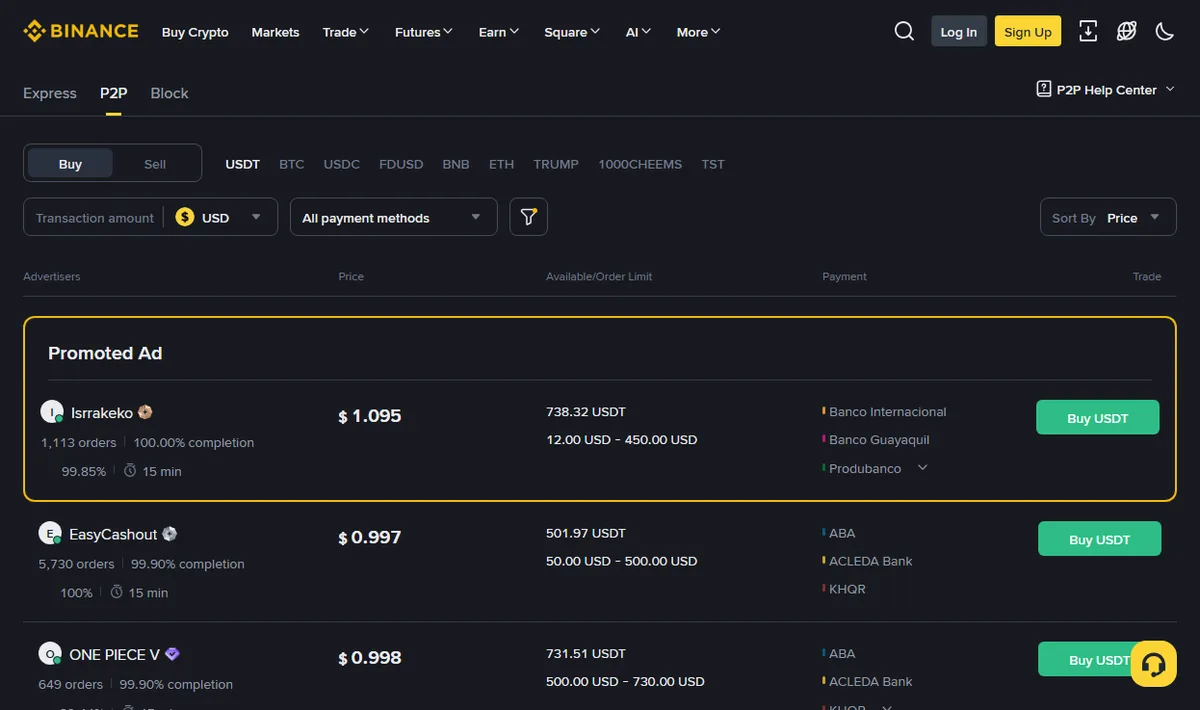
Understanding that is the key point. What the platform guarantees is "if you paid, you get the coins". It does not guarantee that the money you received is clean. When you're the seller, what you receive is money someone transferred to you, and the platform has no way to verify where it came from. That's the payment-side risk, and it's the thing genuinely worth guarding against on this route.
How to reduce payment-side risk
- Pick verified merchants, or counterparties with high volume and completion rates. Not a guarantee, but clearly better odds.
- Break large amounts into several orders. A few orders with different counterparties is safer than one large one.
- Insist on communicating and releasing inside the platform. Anyone asking you to "add me and we'll talk privately" or "release first, I'll transfer right away". Cancel the order and report it.
- Check that the payer's name matches the account details. Payment by a third party is the classic danger sign.
- Don't take an obviously abnormal order for a few cents of spread. A counterparty with a suspiciously good price is often in a hurry to move certain money.
One more thing worth doing from day one: keep complete records of every trade. Order numbers, chat logs, transfer screenshots. Archive all of it. If you're ever asked to explain where money came from, this is the only thing you'll have to show. Record-keeping can't be done retroactively; it only happens at the time.
Fiat rails: easier, but not available everywhere
The second route is a licensed payment provider integrated with the platform, buying coins directly with a card or a local payment method. Your counterparty is an institution rather than an individual, so the payment-side risk layer essentially doesn't exist.
The cost is three things: the regions and payment methods are limited; the channel fee is usually higher than the P2P spread; and per-transaction and daily limits can be less flexible than P2P. For a beginner, if your region supports it, this is the easier place to start. Once you're familiar with the whole flow, then consider whether to use P2P for the cost. Don't take on the most complex route first.
How to check availability
Supported countries, currencies and payment methods change. The reliable approach is to look at the platform's own page at the time, rather than trusting a list in any article — including this one. We don't list specific payment methods precisely because those lists go stale absurdly fast.
Offline OTC: not for beginners
The third route is trading face to face with an individual or a firm. There's no platform escrow, it rests entirely on trusting the counterparty, and if something goes wrong there's no channel to appeal to.
“It's fine, they came through someone I know” is not a safeguard. When this kind of trade goes wrong, you lose both the money and the relationship. Worse, if the other side's money has a problem, you as the recipient still face the burden of explaining it afterwards, without even a platform order to point at.
Our view: the little bit of spread saved doesn't buy off “if it goes wrong there is no record of anything”.
For anyone who just wants to swap into some USDT and earn on it, the risk-reward on this route is poor. It isn't an advanced technique; it's a "stay away unless you know exactly what you're doing".
Where the price difference comes from, and how to read it
The cost of swapping isn't printed like a fee; it's hidden inside the price. Understanding the components stops you paying more for a quote that looks cheap.
Premium
At any moment, USDT's price in a local currency usually differs slightly from its price against the dollar, and that gap is the premium. Local supply and demand set it: more buyers, higher premium. The level itself is nobody's fault, but it determines the exchange rate you actually got on that trade.
The way to judge whether a premium is reasonable is to compare across: look at several quotes at the same moment, and the cluster in the middle is the normal level. Be especially careful with quotes far below the market: treat one as a reason to check the advertiser's record and keep every step inside the platform order, not as a bargain to grab.
One detail to check before you pick a rail: at any given moment, different payment methods carry different quotes. Flip the payment-method filter and compare — same coin, same minute, and the quotes can differ between rails. The reason isn't mysterious: counterparties price settlement speed and reversal risk differently, so they ask for different prices. Which means “what's the rate today” is only half a question until you add “paying how?”
Spread and fees
Cost isn't only the price.
P2P's cost shows up mainly in the bid-ask spread, with the platform usually charging nothing extra; the fiat rails have an explicit percentage fee.
You can't compare those two directly — work out how many coins you end up with in each case and compare that.
Time cost
The most overlooked. Waiting for a counterparty to release, waiting for a channel to settle, appealing a dispute: all take time. Slightly cheaper but two hours of waiting versus slightly dearer and done in five minutes: which is better depends on your situation, but at least count it.
A suggestion: on your first swap, don't take the cheapest quote. Take a counterparty with high volume, good ratings and currently online. Optimise for a few cents of spread once you know the flow. What a beginner loses on a cheap quote usually far exceeds what they saved.
Add the three up: what did one coin actually cost me?
Each of the three looks small on its own. Added up, they are what you really paid, and the arithmetic is plain: total local currency spent ÷ USDT actually received. That number is your true unit price. Hold it next to the market quote at the time and the gap speaks for itself.
A made-up example (invented to show the method, not a real day's rates): you spend 1,000 units of local currency, the fiat rail takes its cut, and 985 USDT lands. Your real unit price is 1,000 ÷ 985 ≈ 1.015. If the busiest P2P advertisers were quoting 1.005 at that moment, you paid roughly one percent over.
One percent doesn't sound like much, so measure it against something: at the current Flexible rate, how long would this money take to earn that one percent back? Put the rate of the day into the interest estimator and you'll get a concrete feel for whether saving that spread was worth another hour of shopping around.
A simple habit we'd suggest: note the number in your phone, one line per purchase. After three or four you stop guessing which rail suits you — the answer is computed from your account, in your region, which beats any guide.
The order to follow when a trade goes wrong
P2P trades occasionally hit problems, and most are procedural. Work through them in order.
-
Don't settle it privately, off-platform
The moment you leave the platform you lose escrow and the right to appeal. The harder the other side pushes to handle it privately, the more you should stay inside.
-
Check the order status before you act
Establish where you are: has the payment gone, have the coins been released, has it timed out. Don't repeat any action before you know the state.
-
Open an appeal when needed, with evidence attached
Transfer screenshots, order number, chat logs: submit them all at once. The more complete the evidence, the faster it moves.
-
If money you received gets frozen
Contact your bank to understand the situation and cooperate in explaining where the funds came from: the trade records you archived earlier are your entire basis for that. Keep the platform's order records too. The process takes patience, but explaining honestly is the only correct path.
To say it once more: the best solution to this category is prevention. A minute more choosing a counterparty saves a lot more than an appeal afterwards.
Four things to do whichever route you take
-
Walk the whole path with a small amount first
On your first swap, use an amount you genuinely don't care about. The point is to learn the flow and check the settlement speed, not to save money.
-
Use an account in your own name
Borrowing someone else's account is wrong from step one.
The paying and receiving accounts must be yours. Using a family member's account, or receiving on someone's behalf, complicates things whatever the reason.
-
Keep records
Orders, screenshots, statements: keep all of it. This is equally useful for tax later, which is covered in is the interest taxable.
-
Check the chain and the address before transferring
If you're moving coins elsewhere, picking the wrong chain or mistyping the address is usually unrecoverable. Unlike the stablecoin itself failing, this kind of operational mistake is entirely in your own hands.
Payment-side risk, spelled out
This is the thing on this route that most deserves being taken seriously, and online opinion is polarised: either it's presented as inevitable, or it isn't mentioned at all. Reality is in between.
How the risk arises
When you're selling and receiving payment, if the money someone transferred to you is connected to a case, that money's path gets traced. Your receiving account sits on that path, so you may be asked to help explain the situation. That's separate from whether you did anything wrong — what's being traced is the money, not the intent.
In reverse, when you're buying (paying for coins), this particular risk is much smaller, because what you're sending is your own normal money. So strictly, traced incoming money is mainly the seller's risk. A buyer's risks sit elsewhere — a quote far below the market, or a counterparty who wants payment outside the order — which is why the quote advice above still applies. Someone starting out who just wants to swap into some USDT and hold it is on the buying side and doesn't need to be unduly anxious about traced money.
What you can do about it
- Prefer verified merchants. Their business is ongoing, so trouble costs them more.
- Split large amounts and spread them across counterparties. Even if a problem occurs, only one order is affected.
- Don't chase a high price. A buy price clearly above the market usually corresponds to money in more of a hurry.
- Leave a trail throughout. Orders, chats, transfer screenshots: store every one. When you need to explain a source, this is your only basis.
- Use accounts in your own name, and never receive or pay on anyone's behalf. Not even for someone you know, however reasonable the reason sounds.
If it does happen
Cooperating, explaining honestly and providing complete records is the only correct way to handle it. Don't try to move funds or destroy records; that turns something explicable into something you can't explain. At the same time, ask the platform to retrieve the order records; legitimate platforms can all provide those.
One very important line: if anyone asks you to "run a payment through for me" or "receive some money on your card and I'll split it with you", however it's packaged, say no. That has stopped being a trading risk and become a different kind of problem. Invitations like this tend to arrive dressed up with tempting terms.
How much to buy, worked backwards from what the money is for
“Let's just do a round number” is an easy way to decide, and an easy one to regret. Buy too much and money that belonged in your bank account is now sitting in an asset you barely know. Buy too little and you're running the whole process again in two days, paying the spread a second time.
Working backwards is easier. Split the money in two. One pile is what you might need within three months — that pile is only ever going into something you can redeem on demand, so how much you buy is really the question of how much you want kept liquid. The other pile is what you are certain you won't touch, and only that pile has any business in a fixed-term product. The rules that separate the two are laid out in how much longer Locked pays, and whether the term is worth it.
One counterintuitive habit worth having: buy in two or three goes rather than all at once. Not to time anything — the premium moves within a single day, so splitting the purchase averages your entry across it. For larger amounts that is far more realistic than sitting there waiting for a “good price”, because the market moves during the half-day you spend waiting.
One thing not worth your time: don't fiddle with the amount to land on a round number of USDT. Available size, per-order limits and each advertiser's inventory all keep changing, and the 1,000.00 you spent ten minutes engineering earns you exactly as much as 987 would have — while the price moved during those ten minutes.
The coins arrived, but they are not anywhere that earns yet
Getting to USDT only moves the money to the starting line. It's easy to assume the job is done here; leave it at that, and two weeks later the balance hasn't moved — because the coins sat in the Spot wallet the whole time, and Spot pays nothing.
Spot and Earn are two different places. Subscribing to a product moves coins from Spot into it; redeeming moves them back. The transfer is free, but you have to do it. Nobody makes that decision for you.
Three things to settle before you move it
- How soon you might need this money. If there's any chance within three months, stay away from anything with a term. The test, plus a list of cases that fail it, is built into can I get this money back on demand — four questions and one verdict.
- When the product you picked starts accruing. The starting point differs by tier, and some don't accrue on the day you subscribe. A day sounds like nothing until you're locking thirty of them.
- Whether the rate floats or is fixed. The number shown by default usually moves; only products explicitly labelled as fixed stay put. The full explanation is in why the Flexible rate changes every day.
And a mistake worth avoiding: buying the coins and immediately putting all of it into the longest term with the highest headline rate. It looks like maximising yield; it is really handing over all of your flexibility in one click. We'd suggest keeping a slice in Flexible — not because Flexible pays well, but because on a platform you're using for the first time you want a pot of money you can move, to confirm that redemption actually works end to end. Once you've redeemed something yourself and watched it land back in Spot, then talk about how much to lock.
Doing it once teaches more than reading ten guides
By this point, the single most useful piece of advice is one line: take a very small amount and walk the whole route.
You'll learn which channel is actually available where you live, how long settlement takes, how quickly counterparties respond, and where the platform's appeal button is. No article can get that information for you, because it varies by region, by time, and by the state of your account.
Scale up after it works and you'll find the whole thing simpler than you imagined, while knowing which steps need care. Conversely, people who go large on the first attempt tend to be meeting an unfamiliar process for the first time at their most tense moment, which naturally raises the error rate.
Suggested order: get the account and the security settings sorted first (sign-up and invite code covers that step), then swap a small amount, and only once that works consider the size and which product tier to use. Skipping the earlier steps and going straight to a large amount is the classic way beginners lose out.
Where to put it once you've swapped, and how the tiers differ, is in the structural differences between tiers.