Home / Product Terms / Where Locked funds go at maturity
What Happens When Binance Locked Earn Matures: Renewed, Moved to Flexible, or Back in Spot
On the end date the position either vanished or got locked for another round. Both are the rules at work. Here is where the principal and the rewards each go at maturity, checked line by line against Binance's Help Center.
Say you put some USDT into a 30-day Binance Locked product a month ago, and today is the end date. You open Earn and one of two things has happened: the position is gone, or it is still sitting there with a new end date 30 days out. Neither is a glitch. Which one you get comes down to a single checkbox on the subscription screen that is easy to tick past without reading: Auto-Subscribe.
According to Binance's Help Center guide to Locked products, the principal has exactly three places it can land at maturity: your Spot Wallet, the Flexible product for the same coin, or another Locked term of the same length. The rewards are a separate story. They have been trickling into Spot every day of the term, so maturity day does not bring a big interest payment with it.
What's in here
- At maturity, the first thing checked is Auto-Subscribe
- A renewal re-locks the principal only, at a new rate
- Is Locked interest paid out at the end of the term?
- Flexible has its own Auto-Subscribe, and it empties Spot
- How to turn off auto-renew before the term ends
- Can you spend the money on the maturity date?
At maturity, the first thing checked is Auto-Subscribe
The Help Center line is short: "Locked Products will be automatically redeemed in full on the redemption date." Two words carry the weight. Automatically means there is no button to press. In full means the whole principal comes out at once, never a slice of it. Where it goes next depends on which of these three cases you are in.
-
Auto-Subscribe off: back to Spot, or into same-coin Flexible
The guide says you can choose to redeem to your Spot Wallet "or subscribe to the Flexible Product of the same cryptocurrency in your Earn Wallet, along with the rewards accrued on the last day." Further down, describing what happens when Auto-Subscribe is disabled, it says the assets "will be automatically transferred to the corresponding Flexible Products or Spot Wallet upon expiry." It never spells out what decides between the two. So don't guess: before the end date, open that position's details and see which destination is selected.
-
Auto-Subscribe on and the product still has room: same term again
In Binance's words, the feature "automatically renews your existing Locked Product position into a new locked term of the same duration upon its expiry." A 30-day position renews for 30 days, a 90-day one for 90. It will not move you to a different term on its own.
-
Auto-Subscribe on but the product is full: no renewal, it goes to Flexible
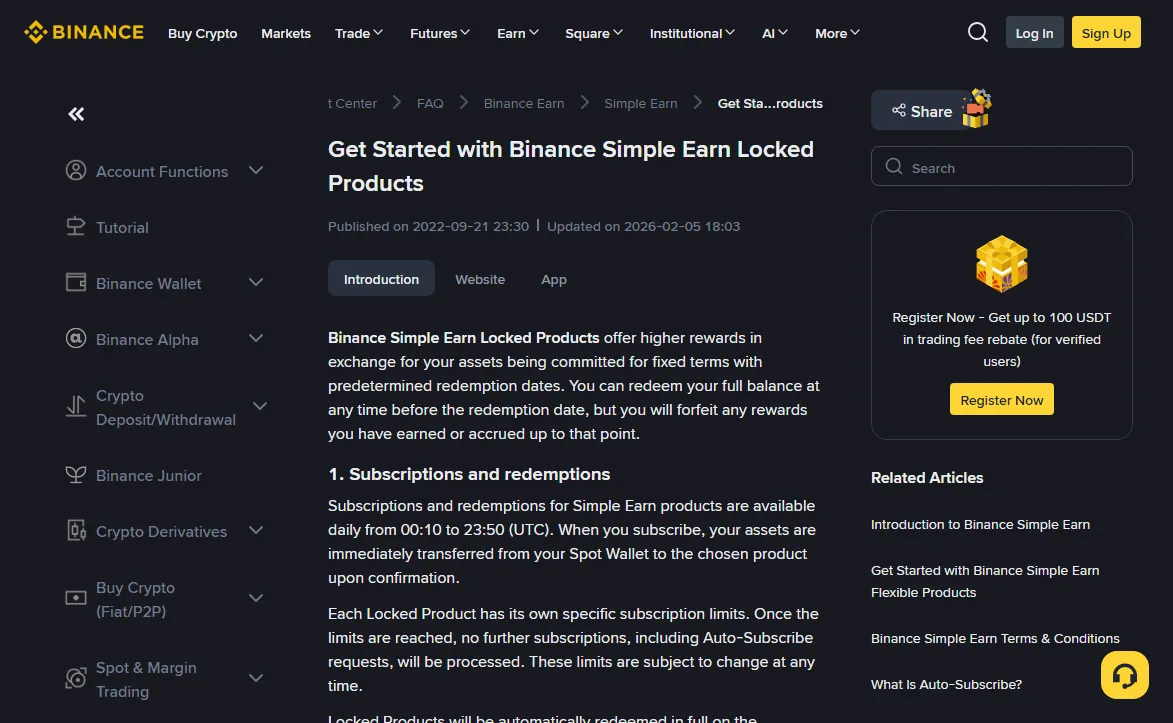
Every Locked product has a subscription limit, and the screenshot shows the consequence plainly: once the limit is hit, nothing more gets processed, Auto-Subscribe requests included. The Auto-Subscribe section of the same page finishes the thought: if the quota is filled, "your position may not be renewed even if Auto-Subscribe is enabled," and the assets are instead subscribed automatically to the same coin's Flexible product. Having the box ticked does not guarantee a renewal.
All three paths share one thing: a normal maturity does not take anything off the principal. What changes is where the money sits, whether it is still earning, and which rate it is earning at.
A renewal re-locks the principal only, at a new rate
How much goes into the next term is stated outright: "This renewal only consists of the original amount of your initial subscription, while rewards earned will be sent to your Spot Wallet." Binance's announcement introducing Auto-Subscribe describes renewal the same way when the feature was launched.
Put in numbers, a 10,000 USDT position on a 30-day term renews as 10,000 USDT. Last term's rewards stay in Spot, or get swept into Flexible (more on that below), and they do not roll into the new term. If you were counting on auto-renew to compound for you, your spreadsheet will come out ahead of your account.
The rate is the other thing to watch. The guide says the APR on a Locked subscription "is not fixed and is subject to change on a daily basis, unless otherwise stated." Some offers are labelled Fixed Rate instead, and the Product Rules page shown at subscription tells you which kind you are in. Either way, a renewed term is a new subscription: it earns whatever applies from the renewal date, not the number you saw a month ago. For why that number drifts in the first place, Why the Flexible APY Changes Every Day walks through the supply-and-demand side; the same forces apply to Locked.
Whether to leave auto-renew on is really a choice between two kinds of inconvenience. With it off, the money lands in Spot or Flexible and may sit at a lower rate for a few days while you look at what is on offer before locking again. With it on, the money gets locked for another full term without you ever looking at the rate, and leaving partway through means playing by the early redemption rules: accrued rewards are forfeited, and the Help Center adds that rewards already distributed are deducted from the principal. If you cannot yet say whether you will need this money next month, off is the safer default.
Is Locked interest paid out at the end of the term?
No. The idea that a Locked product hands back principal plus interest in one go on the last day does not match the published rules. Rewards start accruing at 00:00 UTC on the day after you subscribe; subscription day itself earns nothing. After the first full day, payouts are "calculated and distributed to your Spot Wallet daily between 00:00 and 08:00 (UTC)." The formula on the same page is plain: deposited assets × APR ÷ 365.
UTC is the only clock Binance uses on these pages, so shift it to your own. During US daylight saving time (UTC−4), for example, the 00:00 accrual start falls at 8 p.m. the evening before, and the daily payout window runs from 8 p.m. to 4 a.m.
Suppose you lock 10,000 USDT for 30 days at an assumed 5% APR that never moves (in reality it may). That is 10,000 × 5% ÷ 365 ≈ 1.37 USDT a day, a little over 40 USDT across the term, delivered as a long run of small daily credits. On the end date, what shows up in Spot is the principal (if it was not renewed) plus that final day's reward. Not principal plus 40-something USDT.
That also explains why the Earn screen can look as if the whole month earned nothing: the earnings were never stored on that position line. To check them, go to your Spot Wallet's transaction history and filter by date; the daily credits are all there. If you want an expected figure to compare against, run the term and rate through the interest estimator.
Flexible has its own Auto-Subscribe, and it empties Spot
Same name, different job. On Locked, Auto-Subscribe decides whether a position renews. On Flexible, it decides whether idle coins in Spot get deposited for you. The Help Center guide to Flexible products describes it this way: once it is enabled for a token, "any balance of that token in your Spot Account will be automatically transferred into the corresponding Flexible Product daily at 02:00 and 16:00 (UTC)."
Chain the two rules together. A Locked position matures and the principal drops into Spot. If Flexible Auto-Subscribe is on for that coin, the next 02:00 or 16:00 sweep moves the whole balance, principal and the daily Locked rewards alike, into Flexible.
For earning, that is fine: the money is not idle. It becomes a problem if you meant to sell or withdraw that USDT on maturity day, open Spot, and find a zero balance. You then have to redeem from Flexible first. Flexible redemptions are processed immediately according to the guide, but the same page warns that "daily redemption limits apply to each Flexible Products and are subject to change at any time." Small amounts will not notice. A large withdrawal might.
Two switches, two places. Turning off Auto-Subscribe on a Locked position does not touch Flexible's Auto-Subscribe, and the reverse is also true. If you want matured money to stay put in Spot, check both.
How to turn off auto-renew before the term ends
The guide says you can disable Auto-Subscribe in your Earn Wallet "to stop any subsequent subscriptions at any time before the end of the locked period." The deadline matters: change it before the end date. Once the term rolls over, the renewal has already happened and switching it off only affects the term after that.
As for where the switch lives, Binance points to two spots: the subscription pop-up, and the [Auto-Subscribe] box next to the product in your Earn Wallet. Flexible's switch is in the same places, and Flexible also has an [Auto-Subscribe Setting] page for managing several coins at once. Menu names shift whenever the app is redesigned, so it is usually quicker to open the position itself in Earn and look for anything labelled Auto-Subscribe than to follow a menu path from a help article.
A few days before maturity, check three things:
- The end date and its time zone. Every time in the Help Center is UTC. Which time zone the app uses for the date on your position is whatever that position's detail page shows.
- Auto-Subscribe on this Locked position. On means it renews; off means it comes out.
- Auto-Subscribe on the same coin's Flexible product. That decides whether the money stays in Spot once it is out, or gets swept into Flexible.
If you have not decided whether to lock this money again, or for how long, Locked Pays More: How Long Should You Lock For sets out how to re-run that decision on maturity day.
Can you spend the money on the maturity date?
Don't plan a payment around having the money the morning of the end date. Three reasons, all from the same Help Center pages.
One: Binance does not publish a separate settlement time for a normal maturity. The "within the next 72 hours" figure on that page belongs to early redemption and should not be read across to a normal maturity, though it does show that these transfers are not always instant. The page also notes that extreme volatility, network delays or heavy redemption volume can delay redemptions.
Two: subscriptions and redemptions run daily from 00:10 to 23:50 (UTC). Anything that lands right at the edge of that window waits for the next one.
Three: even with the principal back in Spot, you are still two steps from spendable money, a sale and a withdrawal, each with its own limits and checks. The two steps after redemption are the slow part covers those. If a bill is due on a fixed date, pick a term that ends a few days before it rather than on the day.
Still unsure which tier lets you get a particular amount back when you need it? Run it through the redemption checker, or read the When You Can Get It Back series in order.